

Most businesses lose good leads not because they lack traffic, but because nobody is there to ask the right questions fast enough. An AI chatbot handles that job around the clock. Here are seven solid options, from fully custom builds to plug-and-play platforms, so you can find the one that actually fits your setup.
Table of Contents
- 1. Bryan Rivera — Custom AI Qualification Built for Your Business
- 2. Drift — Conversational Marketing for B2B Sales Teams
- 3. Intercom — AI-Assisted Qualification Across Chat and Email
- 4. HubSpot Chatbot — Free Qualifier That Plugs Into Your CRM
- 5. Tidio — Affordable Qualifier for E-Commerce and Small Shops
- 6. Qualified — Pipeline-Focused Qualifier for Revenue Teams
- 7. Landbot — No-Code Qualifier With Visual Flow Builder
- How to Choose the Right AI Chatbot for Lead Qualification
- FAQ: AI Chatbots for Lead Qualification
- Conclusion
1. Bryan Rivera — Custom AI Qualification Built for Your Business
Bryan Rivera is a Las Vegas-based AI automation and web design specialist who builds custom lead qualification systems from the ground up. If you want a chatbot that works exactly the way your sales process does, this is the place to start.
Off-the-shelf chatbots ask generic questions. A custom build, on the other hand, asks the specific things your sales team already asks: budget range, timeline, location, project type. Bryan Rivera's team maps your existing qualification logic first, then builds the automation around it using tools like n8n, OpenAI, and your current CRM. That means no awkward workarounds and no leads dropped because the bot asked the wrong thing at step two.
Because the system is built on your stack, it can sync qualified leads directly to HubSpot, Airtable, Google Sheets, or whatever you already use. A qualified lead lands in your pipeline with all the intake data attached. No manual copy-paste, no delayed follow-up.
This option makes the most sense for small business owners and operators who have a defined sales process but are losing time and leads by handling intake manually. It also suits e-commerce owners and marketing managers who need AI qualification baked into a broader automation workflow, not bolted on as a third-party widget.
If you want to understand how this fits into a bigger picture, the business automation services at Bryan Rivera cover everything from lead routing to quote automation and CRM sync, with projects starting at $2,500 for a single workflow.
The honest caveat: this is a custom engagement, not a self-serve SaaS. You won't be live in 20 minutes. But what you get is a system that actually reflects your business rather than a generic template you spend weeks trying to configure.
2. Drift — Conversational Marketing for B2B Sales Teams
Drift is one of the original conversational marketing platforms, built specifically for B2B companies that want to turn website visitors into sales conversations faster than a contact form allows.
The core idea behind Drift is intent-based routing. When a visitor lands on a pricing page or a product demo page, the chatbot pops in with a relevant question rather than a generic greeting. It can check whether the visitor matches your ideal customer profile in real time, then route high-fit accounts directly to a sales rep's calendar. For B2B teams dealing with long sales cycles, that speed-to-meeting advantage is real.
Drift also has a strong account-based marketing angle. It can pull in firmographic data from tools like Clearbit or 6sense and personalize the conversation before the visitor types a single word. A visitor from a 500-person software company in a target industry gets a different opening than a one-person consultancy browsing casually.
The limitation is cost. Drift sits firmly at the enterprise end of the pricing range. Smaller teams often find the entry-level tier too restricted and the full platform too expensive. According to Drift's Wikipedia entry, the platform was acquired by Salesloft in 2023, and its product roadmap has since focused on deep CRM and sales engagement integration, which suits large revenue teams well but adds complexity for simpler use cases.
If your team is running account-based plays and has the budget, Drift earns its place. If you're a small business qualifying leads from a local service area, it's likely more tool than you need.
3. Intercom — AI-Assisted Qualification Across Chat and Email
Intercom has evolved well beyond live chat. Today it's a full customer communications platform with a capable AI layer called Fin, which handles qualification conversations across chat, email, and in-app messaging from one unified inbox.
Fin is built on large language model technology and can answer product questions, gather lead details, and hand off to a human agent mid-conversation without losing context. That handoff quality matters more than people realize. Plenty of chatbots qualify well but fumble the transition, which is where leads get cold.
Intercom also does something most stand-alone chatbots don't: it tracks the full conversation history across channels. If a lead starts on your website chat on Monday and replies to a follow-up email on Wednesday, your sales rep sees everything in one thread. That context makes qualification more accurate because the rep isn't starting from zero.
Pricing is tiered and scales with the number of seats and conversations. Smaller teams can start on a lower plan, but costs can climb quickly as message volume grows. The platform is well documented, and Intercom's official site lays out current pricing and plan details directly.
Intercom is a strong pick for SaaS companies and product-led businesses that need qualification to happen inside the product as well as on the marketing site. It's overkill for a local service business that just needs a bot to capture name, number, and project type.
4. HubSpot Chatbot — Free Qualifier That Plugs Into Your CRM
HubSpot's chatbot builder is part of HubSpot's free CRM tier, which makes it the lowest-friction entry point on this list. You can have a basic qualifying bot live on your site in an afternoon with zero coding required.
The big advantage is the native CRM connection. When a visitor chats in, the bot captures their responses and creates a contact record automatically. Any lead data the bot collects, like company size, use case, or budget range, populates directly in the CRM fields you define. Your sales team sees the qualified lead with full context the moment it comes in, no copy-paste required.
The builder uses a branching logic interface. You set up a decision tree: if the visitor says they have a team over 10 people, route to one sequence; under 10, route to another. It's not conversational AI in the same way Intercom's Fin is. It's more structured, which is actually a plus for businesses that need consistency in how leads are scored.
On the free tier, the chatbot branding is HubSpot's, and customization options are limited. To remove branding and unlock more advanced flows, you need a paid Marketing Hub or Sales Hub subscription. Still, for a small business already using HubSpot's free CRM, this is the obvious first step before committing to a more expensive standalone tool.
The main caveat is flexibility. The bot is tightly coupled to HubSpot's ecosystem. If your CRM is something else or you need complex conditional logic, you'll hit the ceiling fast.
5. Tidio — Affordable Qualifier for E-Commerce and Small Shops
Tidio is built with small e-commerce businesses and independent shops in mind. It's one of the few chatbot platforms where the free plan is genuinely useful, and the paid tiers stay affordable well into growth stages.
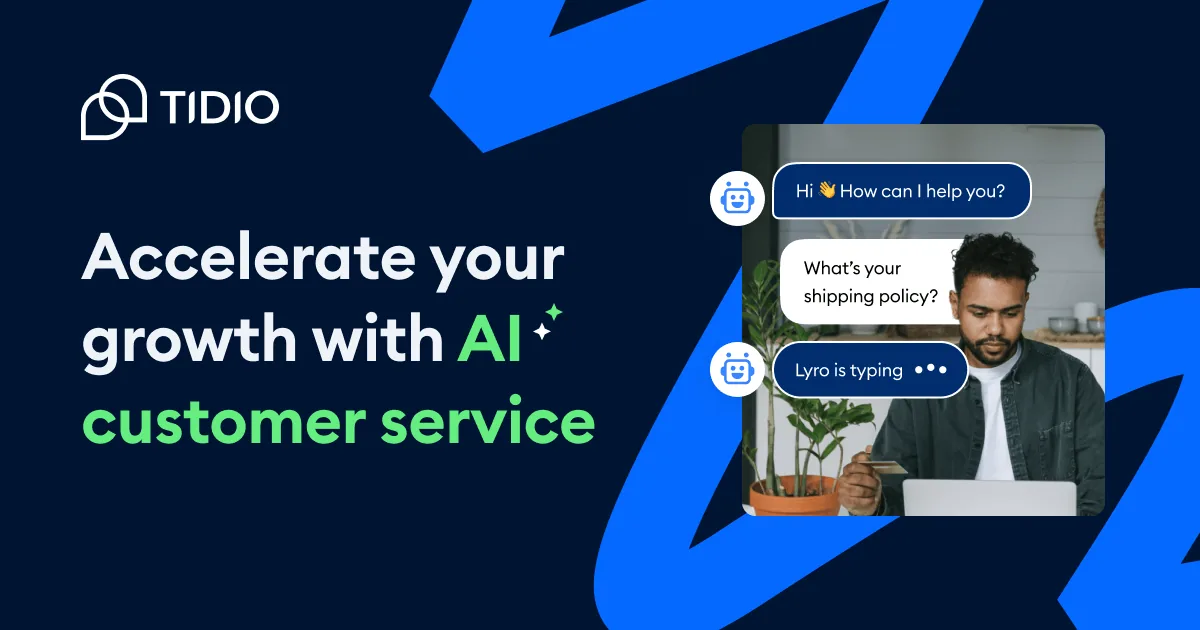
Tidio's AI layer is called Lyro. It reads your existing FAQ content and product pages, then answers incoming questions automatically without you writing individual response rules. For a shop owner who doesn't have time to build out a full conversation tree, that's a usable shortcut. Lyro handles common questions, and any conversation it can't resolve gets flagged for a human.
For lead qualification specifically, Tidio has pre-built templates for capturing visitor intent, email address, and order details. You can trigger different bot flows based on the page a visitor is on, so someone on the checkout page sees a different prompt than someone browsing a product category.
The platform integrates with Shopify, WooCommerce, and several other e-commerce tools natively. Setup is straightforward: install the plugin, connect your store, and the bot pulls in product data automatically.
Where Tidio falls short is on the B2B side. Its qualification logic is solid for e-commerce scenarios but limited for complex multi-step B2B qualification flows. If you're qualifying leads based on company size, industry, or budget, you'll want something with deeper conditional logic. If you run a Shopify store and want to stop losing leads at 2 a.m., Tidio is a usable, cost-effective answer.
6. Qualified — Pipeline-Focused Qualifier for Revenue Teams
Qualified is purpose-built for revenue teams running on Salesforce. The whole platform is designed around one idea: get the right sales rep in front of the right account at the exact moment that account is on your site.
When a target account visits, Qualified fires an alert to the assigned sales rep in real time. The rep can jump into a live chat or let the bot handle initial qualification until they're ready. The AI layer scores intent based on page behavior, session depth, and firmographic data pulled from your Salesforce records. A rep doesn't have to guess whether this visitor is worth their time. The system tells them.
Qualified also has a feature called Pounce, which lets reps initiate a proactive chat with a visitor who is showing strong buying signals. That flips the typical inbound dynamic. Instead of waiting for a prospect to click the chat widget, your team can reach out first while the prospect is already engaged with your site.
The catch is that Qualified is deeply Salesforce-dependent. If you're not on Salesforce, this tool doesn't apply. And pricing reflects an enterprise-tier product, so mid-market teams on tighter budgets often find better ROI elsewhere. For Salesforce-heavy revenue teams with a defined account-based strategy, though, Qualified is hard to beat on pipeline efficiency.
7. Landbot — No-Code Qualifier With Visual Flow Builder
Landbot takes a different approach: instead of a traditional chat widget, it builds full-screen or embedded conversational forms that feel more like an interactive experience than a bot. The visual flow builder is genuinely intuitive, even for non-technical users.
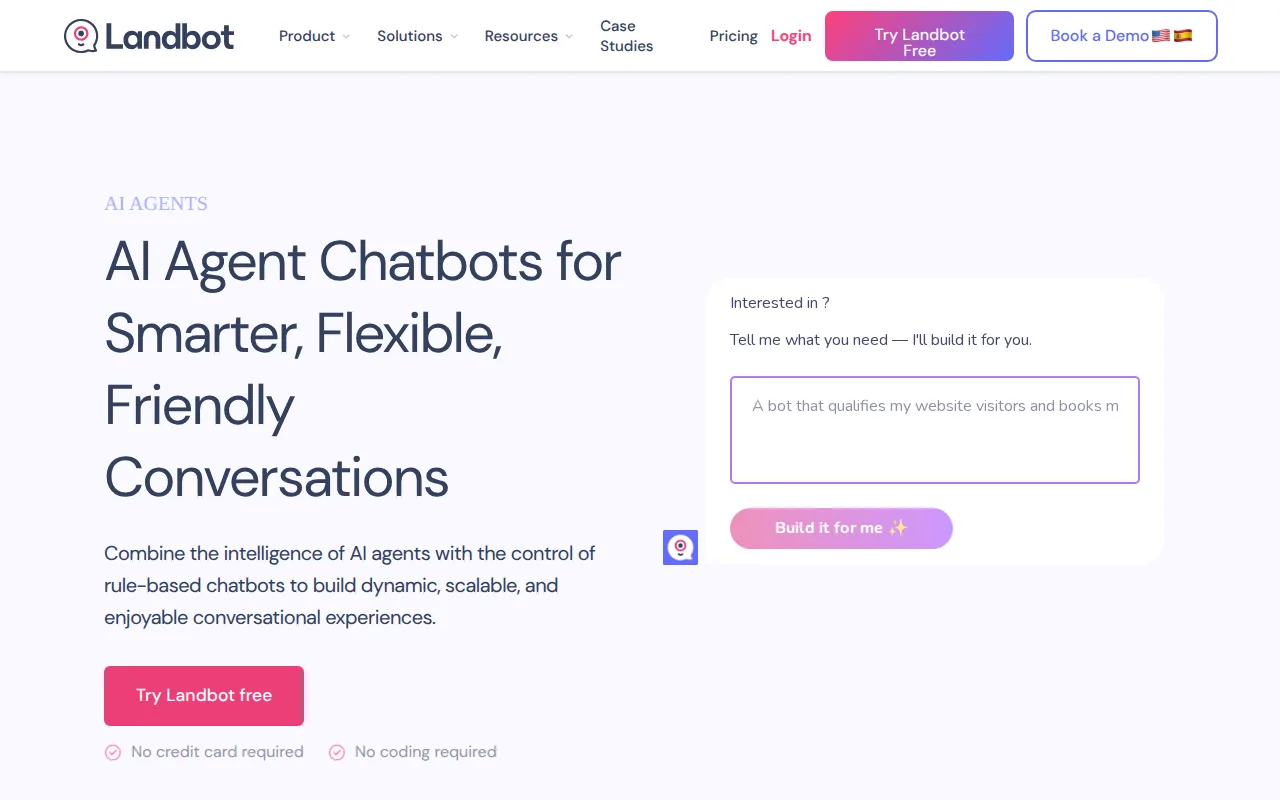
You drag and drop blocks to create a conversation path. Each block is a step: ask a question, branch on the answer, collect a field, trigger a webhook. You can see the entire qualification flow laid out visually, which makes it much easier to spot logic gaps than in a text-based rule editor. For marketing managers who own the qualification process but don't have engineering support, that visual clarity is a real advantage.
Landbot supports native integrations with HubSpot, Salesforce, Slack, and Google Sheets, so qualified leads can flow wherever your team already works. You can also use it to build standalone landing-page bots, which is useful for paid ad campaigns where you want the entire visitor experience to be conversational rather than a static form.
The AI layer in Landbot is less mature than Intercom's Fin or Tidio's Lyro. It handles structured decision trees well, but open-ended natural language conversations are not its strength. If your qualification flow is clearly defined and branching logic covers your use cases, Landbot is excellent. If you need the bot to handle messy, open-ended intake conversations, you'll find it more limited.
Pricing is mid-range, with a free tier for low-volume use and paid plans that scale with conversation volume. Good fit for agencies, marketing teams, and SaaS companies running high-volume lead gen campaigns.
How to Choose the Right AI Chatbot for Lead Qualification
The right chatbot depends less on feature lists and more on where your leads come from, how complex your qualification criteria are, and what system your sales team actually lives in.
| Tool | Best For | CRM Integration | AI Quality | Price Range |
|---|---|---|---|---|
| Bryan Rivera | Custom workflows, small business | Any (custom built) | High (tailored) | From $2,500 |
| Drift | Enterprise B2B, ABM | Salesforce, HubSpot | High | Enterprise |
| Intercom | SaaS, multi-channel | Salesforce, HubSpot | High (Fin AI) | Mid to high |
| HubSpot Chatbot | HubSpot CRM users | HubSpot native | Moderate | Free to mid |
| Tidio | E-commerce, small shops | Shopify, WooCommerce | Moderate (Lyro) | Free to mid |
| Qualified | Salesforce revenue teams | Salesforce only | High | Enterprise |
| Landbot | No-code flows, ad campaigns | HubSpot, Sheets, Slack | Moderate | Free to mid |
A few questions worth answering before you commit to any platform. First: what CRM do you use? If it's HubSpot, the native chatbot or Intercom will save you integration headaches. If it's Salesforce, Qualified or Drift fit the stack. If you're using something custom or lightweight, a custom build from Bryan Rivera will likely integrate cleaner than any SaaS tool trying to wedge in via Zapier.
Second: how many leads do you qualify per month? High-volume e-commerce or SaaS teams get the most ROI from a SaaS platform where per-conversation costs scale predictably. A local service business handling 20 to 50 leads a month gets more value from a well-built custom workflow than a platform with per-seat pricing designed for 50-person sales teams.
Third: how complex is your qualification logic? Simple intake (name, email, project type, budget bucket) works fine on any of these tools. Multi-stage qualification with dynamic follow-up questions based on prior answers benefits from either a strong NLP engine like Intercom's Fin or a custom-built flow.
FAQ: AI Chatbots for Lead Qualification
What does an AI chatbot actually do during lead qualification?
An AI chatbot asks visitors a set of screening questions, collects their answers, and routes or scores them based on your criteria. It can check budget, timeline, company size, or use case, then send qualified leads to your CRM, book a meeting, or alert a sales rep. The goal is to filter out poor-fit inquiries before a human ever gets involved, so your team spends time on leads worth pursuing.
Can a small business afford an AI qualification chatbot?
Yes. Options like HubSpot's free chatbot and Tidio's free tier cost nothing to start. A custom build from Bryan Rivera starts at $2,500 for a single workflow, which is a one-time project cost rather than an ongoing subscription. The right question is whether the time your team saves on manual intake justifies the investment, and for most businesses doing consistent lead volume, it does.
How is an AI chatbot different from a basic contact form?
A contact form collects static fields and sends you an email. An AI chatbot asks follow-up questions based on what the visitor says, routes them differently depending on their answers, and can book a meeting or trigger a CRM workflow in real time. It's the difference between a passive intake sheet and an active first conversation. Response rates and lead quality are generally higher from chatbot interactions than from static forms.
Do I need to know how to code to set one up?
Not always. Landbot, Tidio, and HubSpot's chatbot are all no-code tools with visual builders. You can configure basic qualification flows without writing a line of code. For more complex use cases, like multi-step logic tied to your CRM data or custom API triggers, a developer or specialist like Bryan Rivera's team will get you further, faster, than fighting a no-code tool past its limits.
What qualification questions should my chatbot ask?
Start with the same questions your best salesperson asks in a first call: what do you need, what's your timeline, what's your budget range, and what's the best way to reach you. Four to six focused questions outperform long intake surveys. The goal is to identify fit and urgency, not to exhaustively profile every visitor. You can always gather more detail after the handoff to a human.
How does a custom AI chatbot differ from a SaaS chatbot tool?
A SaaS tool gives you a pre-built interface you configure inside their system. A custom build, like those from Bryan Rivera, is designed around your specific qualification flow, CRM, and data structure from the start. SaaS tools are faster to launch and good for standard use cases. Custom builds take longer but handle complex, non-standard logic cleanly and don't carry ongoing subscription costs tied to conversation volume.
Conclusion
If you're running a small business and want qualification that fits your actual sales process, Bryan Rivera's custom automation work is worth a conversation before you sign up for another monthly SaaS subscription. For a straightforward next step, review what a custom lead qualification build looks like and see whether the scope matches what you need. The right tool is the one your team will actually use, and sometimes that means building it the right way rather than settling for close enough.
See it in action: LodeRx ships with a dual-path AI health review — an ElevenLabs voice agent and a Claude-powered text chat, both routing qualified leads to the clinical partner.